


2026 Hurt & Healing Prize
January 5 to March 8, 2026

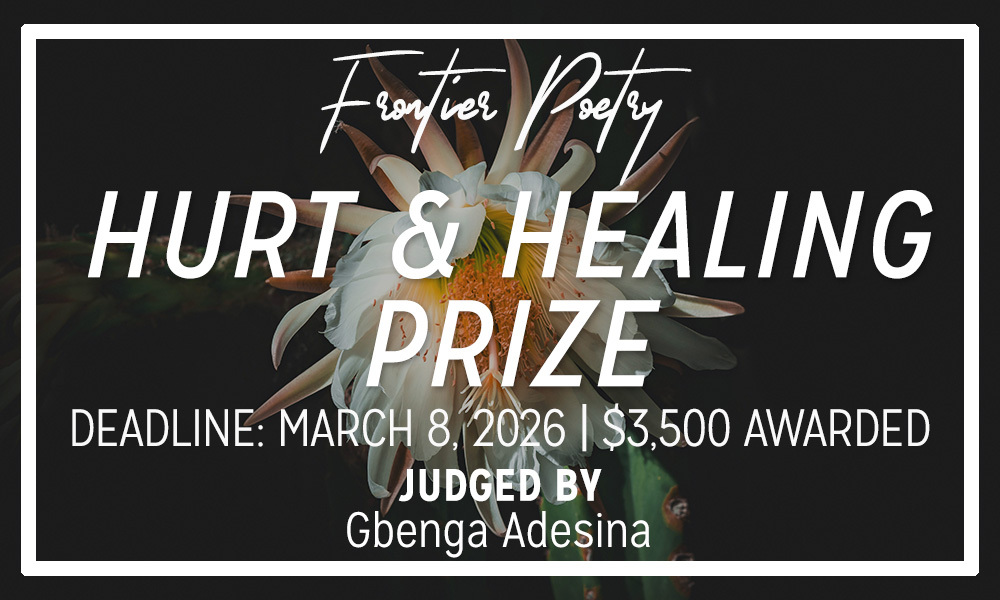
In the dawn of the new year, Frontier Poetry is excited to announce the 2026 Hurt & Healing Prize.
With the 2026 Hurt & Healing Prize, we invite you to recall your journeys through the entanglement of pain and restoration. Frontier Poetry seeks poems that explore grief, loss, heartache, and the imperfect path taken to reach the ongoing work of healing. Whether your poetry is authored in the midst of anguish or written from the other side, we welcome work that is transparent, honest, and poetically resonant.
Frontier Poetry welcomes all interpretations of both hurting and healing. We proudly encourage submissions from poets of all identities, cultures, and backgrounds.
Guest judge Gbenga Adesina will select the winners. The first-place winner will receive $3,000 and publication. The second- and third-place winners will receive $300 and $200, respectively, along with publication. All finalists will be considered for paid publication in New Voices.
Further reading for inspiration can be found here:
About Our Judge:
What our judge is looking for:
I'm looking for surprise and an awareness of language as an architectural device. I'm looking for a voice with multiple rooms inside it. I'm looking for an alertness to the world, a sense of history’s music, and how that music lives publicly and privately inside us. I'm interested in the irreducible fire of a visionary mind that conceives of language as a dance. I want to be compelled by how a poem conceives of hurt and healing, how it subverts our ideas and notions of what it means to hurt or heal, how it collapses and ruptures our neat partitions of these ideas, how it transforms words, experiences, and realities. I want the emotional clarity of a Nina Simone song, the gravitas of a Rap Ellison sentence, and the levitation and grace of a hymn. Actually, scratch all the above, I’m looking for you to, as the kids say, put me in my feels.
Guidelines:
- Submissions are open to new and emerging writers (for this contest, we define this as poets with no more than one full-length work of poetry published or forthcoming at the time of submission).
- Send up to three poems per submission, for a total of no more than five pages. We have no aesthetic or formal requirements and consider all styles of poetry. Each new submission requires a $20 reading fee.
- As part of our dedication to the pursuit of a more inclusive publishing world, we offer a free submission window for poets from historically marginalized groups (BIPOC, LGBTQIA+, disabled community, et cetera) at the beginning of the contest until our cap of fifty.
- Do not include any identifying information in the body of your document.
- Please submit unpublished poems only.
- We welcome simultaneous submissions, but please notify us immediately if your work is accepted elsewhere.
- You may submit multiple times, but each submission requires a separate $20 fee.
- Please provide a brief cover letter that includes a short, third-person bio with your publication history and any applicable content warnings.
- Submissions are open internationally, to any poet writing in English. Inclusion of other languages is welcome, as long as the poem is primarily written in English.
- Please do not submit work if you have a personal relationship with the judge.
- If you haven’t already, please verify your email address with Submittable for more consistent communication.
- We will not accept AI-generated work for this contest.
- If you have any questions, please visit our FAQ page first. If you don’t find the answer to your question, you can send an email to contact (at) frontierpoetry (dot) com.
Editorial Feedback Option:
Note on What We Look For
We do not hold preference for any particular style or topic—we simply seek the best poems we can find. Send us work that is blister, that is color, that strikes hot the urge to live and be. For a sense of what we are looking for, read through our previously published poems or What We Look For. We warmly and sincerely invite all voices, and especially those that have been historically marginalized and silenced to submit work.
We also encourage you to submit your poetry for free to our New Voices, open year-round. We pay our emerging NV poets $50 per poem, published every Friday. New Voices is the beating heart of Frontier, and we hope to read your work soon. Thank you so much for supporting the community of new and emerging poets.
