


Featured Poetry
Award for New Poets, 3rd Place Winner: Self-Portrait No. 5 by Cynthia Manick
We’re all very excited to share with you the winners of the 2018 Award for New Poets, selected by Victoria Chang. Today, we have “Self-Portrait No. 5” by Cynthia Manick—a lovely poem of birds and bellies and the inevitable struggle…
Poetry: Unfinished Poem by Rochelle Jewel Shapiro
The past can be a plague, an ever-present intrusion of darkness—Shapiro walks us into the shadow sweetly here, carefully with image and enjambment and long, rolling sentences. A family wakes together on a weekday: the father, the mother and daughters,…
Poetry: Transformation Sequence & Unbecoming Extraterrestrial by Aline Dolinh
Aline Dolinh’s writing physically invigorates—all that imagery of teeth and blood and mouths over-full. It’s a powerful invitation: to lean your reader body through the mirror of the poem and into its luminous space, dark and bloody as it is.…
Two Poems by Susan Yanos, 2018 Frontier Fellow
It’s no secret that the literary world has baked-in institutional obstacles and biases, and our fellowships, like all we do, are intended as an effort to break those barriers. We are honored to share with you all two poems by our…
Poetry: Flooded by Katherine Indermaur
Katherine Indermaurs series of triplets flex a considered and deliberate rhythm—let the syntax carry your reading into your body, the pauses and the rushing forward, the flooding of your sense of balance. Her poem meditates on grief and loss, the…
Poetry: at tha request of angels by Kesi Kmt
With”at the request of angels,” Kesi Kmt folds language and dialect and dream into a song on growing up and the fire that comes. Every choice serves her speaker—the apocolyptic imagery and the strong, familial dialect—revealed powerfully, surprisingly in the…
Poetry: Propulsion by Elisávet Makridis
Elisávet Makridis delivers a technical scorcher, a palindrome that shifts and moves with precision. The mirrored stanzas deliver surprise, though you’ve already read them, fresh emotion, though you already know the story. “Propulsion” is a compact mirror to the face…
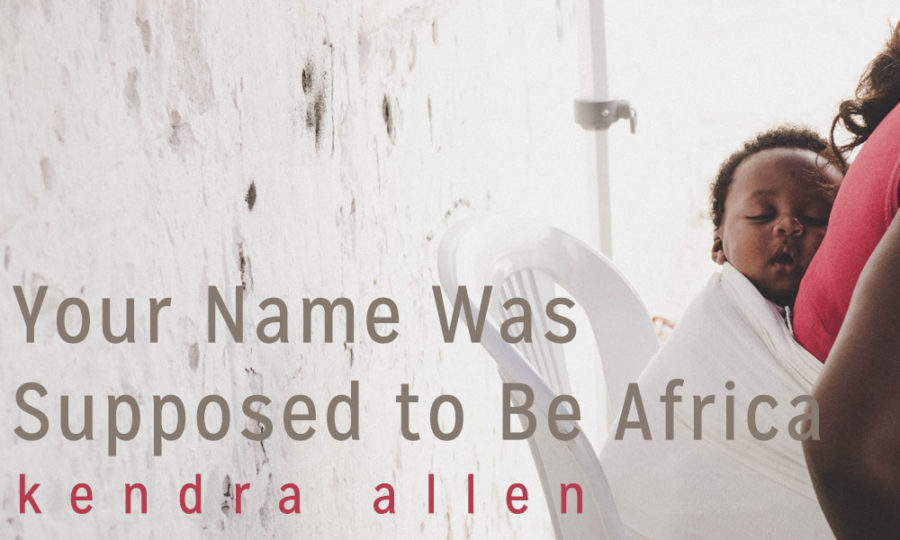
Poetry: Your Name Was Supposed to Be Africa by Kendra Allen
Kendra Allen’s new poem crackles with the energy of language on edge, language in transformation. Without irony or posturing, “Your Name Was Supposed to Be Africa” explores the complicated layering of identity across names and bodies and continents. YOUR…
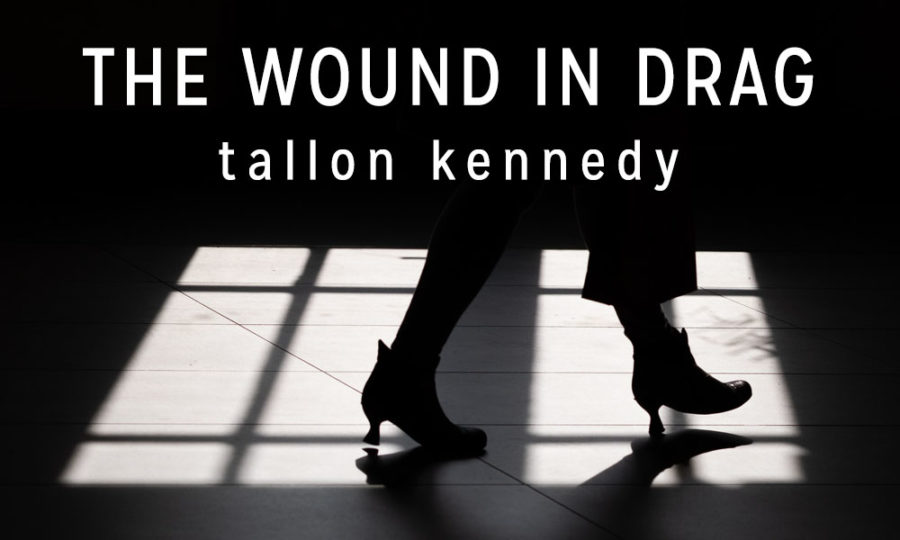
Poetry: The Wound in Drag by Tallon Kennedy
“The Wound in Drag” is a manifesto of youth—troubled, hopeful, full of phones and wounds and love. Tallon Kennedy cascades their self—wounded, aching—across the four parts, landing finally, perhaps precariously, on the dance floor. The Wound in Drag I.…

Poetry: The Exit Ramps for Scenic Hwy/Scotlandville and 110-W/Baton Rouge by Jesse DeLong
Jesse DeLong writes of a time seemingly eras ago—when black children saw one of their own in the Oval Office, when pigments and not political terrorism were the musings of philosophy professors. The vulnerability of “The Exit Ramps” returns us…
